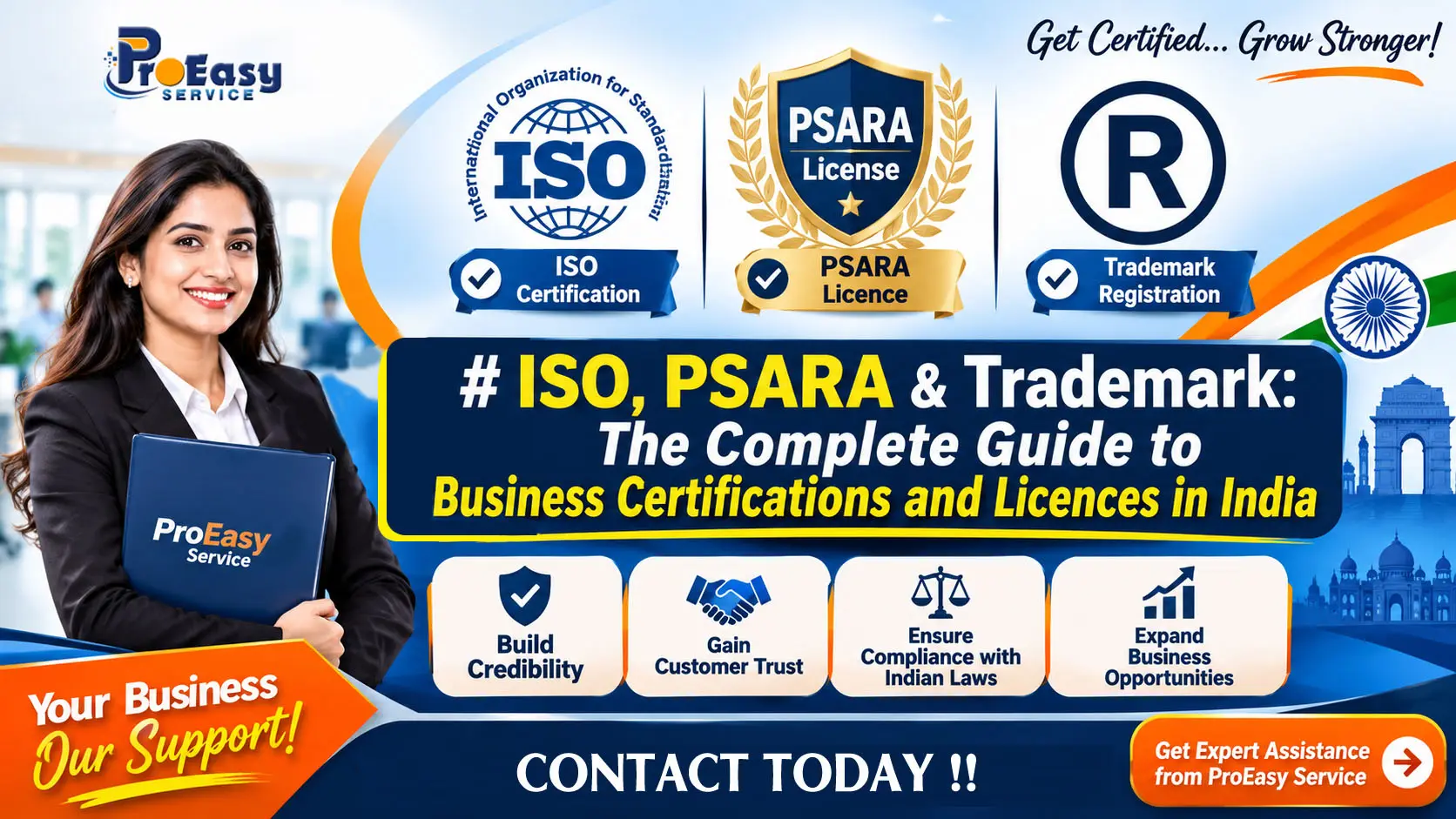
ISO, PSARA & Trademark: The Complete Guide to Business Certifications and Licences in India
Learn how ISO certification, the PSARA licence and trademark registration work in India: who needs them, the process, documents and benefits. Read the guide.
Introduction
In business, trust is currency. Customers, tender committees and partners want proof that your company delivers quality, operates legally and owns its brand. That proof comes from the right certifications and licences.
This guide explains three of the most important ones for Indian businesses: ISO certification (quality and management systems), the PSARA licence (mandatory for private security agencies) and trademark registration (legal protection for your brand).
Certifications vs Licences: What's the Difference?
People often use the two words interchangeably, but they serve different purposes.
- Certification (such as ISO) is usually voluntary. It proves that your processes meet an international standard, and it strengthens your credibility.
- Licence (such as PSARA) is a legal permission. Without it, you cannot carry out that business activity.
- Registration (such as a trademark) gives you legal rights over something you own, in this case your brand.
1. ISO Certification
What is ISO certification?
ISO standards are published by the International Organization for Standardization. A business that follows a standard and passes an audit by an accredited certification body receives an ISO certificate. Popular standards include:
- ISO 9001: Quality Management System
- ISO 14001: Environmental Management System
- ISO 45001: Occupational Health and Safety
- ISO 27001: Information Security Management
Benefits of ISO 9001 for small businesses
- Builds customer confidence and brand reputation
- Meets the requirements of many corporate and government tenders
- Reduces errors, rework and wastage through clear processes
- Improves team accountability and documentation
- Supports growth, since consistent processes scale better
ISO certification process (step by step)
- Choose the right standard for your business and customers.
- Gap analysis to compare your current processes with the standard.
- Documentation of policies, procedures and records.
- Implementation and training of your team.
- Internal audit and management review to find and fix gaps.
- Certification audit (Stage 1 and Stage 2) by an accredited certification body.
- Certificate issued, followed by periodic surveillance audits to keep it valid.
Tip
Always check that the certification body is accredited. A certificate from an unaccredited body may not be accepted by tender authorities or large customers.
2. PSARA Licence
What is PSARA?
PSARA stands for the Private Security Agencies (Regulation) Act, 2005. Any business that provides security guards or private security services must hold a valid PSARA licence from the controlling authority of the state where it operates.
Who needs a PSARA licence?
- Private security agencies providing guards to offices, factories, malls, banks and residential societies
- Facility management companies that supply security personnel
- Any company that deploys guards as a paid service to others
PSARA licence process (step by step)
- Check eligibility of the agency and its owners or directors under the Act and your state's rules.
- Register your business entity (proprietorship, partnership, LLP or company).
- Prepare documents, which commonly include identity and address proofs, police verification or character certificates, entity registration documents, office proof, and financial and tax documents.
- Apply to the state controlling authority, online or offline as per the state's process, and pay the prescribed fee.
- Verification and inspection by the authorities.
- Licence issued, after which you must arrange training and verification for your guards.
Key compliance points
- Guards must be trained as required under the Act and the applicable rules.
- Guards must be verified and carry proper identification.
- Licences are issued state-wise, so operating in another state needs a separate licence there.
- The licence is valid for a fixed period and must be renewed before it expires.
- Maintain registers, records and returns as required by your state.
State-wise note: Forms, fees, timelines and portals differ across states, so always follow your state's PSARA guidelines.
3. Trademark Registration
What is a trademark?
A trademark is a word, name, logo, symbol, tagline or combination that identifies your goods or services and distinguishes you from competitors. In India, trademarks are registered with the Trade Marks Registry under the Trade Marks Act, 1999.
Why register your trademark?
- Gives you exclusive legal rights to use the mark for your goods or services
- Lets you take legal action against copycats and infringers
- Builds brand value and makes your business easier to sell or franchise
- Allows you to use the ® symbol after registration
- Registration is generally valid for 10 years and can be renewed
Trademark registration process (step by step)
- Trademark search to check whether a similar mark already exists.
- Select the correct class of goods or services for your business.
- File the application with the Trade Marks Registry along with the required details and fee.
- Examination by the Registry, which may raise objections you need to reply to.
- Publication of the mark in the Trade Marks Journal.
- Opposition period, during which third parties can object.
- Registration certificate is issued if there is no objection or if objections are resolved.
You can use the ™ symbol as soon as you file the application.
Common trademark mistakes
- Skipping the trademark search and facing rejection later
- Choosing a name that is too generic or descriptive
- Filing in the wrong class
- Ignoring examination reports or hearing notices
- Forgetting to renew the trademark on time
Documents Checklist at a Glance
Which One Do You Need First?
- Starting a security agency? Begin with your business registration and PSARA licence, since you cannot operate without it.
- Bidding for tenders or B2B contracts? Consider ISO 9001 to meet quality requirements.
- Launching a new brand or product? Register your trademark early, before competitors do.
How ProEasy Service Can Help
Applying for certifications and licences means paperwork, follow-ups and strict timelines. ProEasy Service supports businesses with ISO certification assistance, PSARA licence application and compliance, and trademark search and registration, so you can focus on running your business.
Need help with ISO, PSARA or trademark registration? Contact ProEasy Service today.
Frequently Asked Questions (FAQs)
1. Is ISO certification mandatory in India?
No. ISO certification is voluntary, but many tenders and corporate customers prefer or require it.
2. How long does ISO certification take?
It depends on the size of your business and how ready your processes are. Small businesses can often complete it in a few weeks to a few months.
3. Who needs a PSARA licence?
Any agency that provides private security guards or related security services to others must hold a PSARA licence from the controlling authority of the state where it operates.
4. Is a PSARA licence valid across India?
No. PSARA licences are issued state-wise. If you want to operate in another state, you generally need a licence from that state too.
5. What happens if I run a security agency without a PSARA licence?
Operating without a licence is a legal violation and can lead to penalties and prosecution, apart from losing contracts.
6. How long is a trademark valid?
A registered trademark is valid for 10 years from the date of application and can be renewed for further periods.
7. Can I use the ® symbol after filing a trademark application?
No. Use ™ after filing, and use ® only after the trademark is registered.
8. Should I do a trademark search before applying?
Yes. A search helps you avoid conflicts with existing marks and reduces the risk of objections or rejection.
9. Can ProEasy Service handle all three for my business?
Yes. ProEasy Service can guide you through ISO certification, PSARA licensing and trademark registration, including documentation and follow-ups.
Disclaimer: This article is for general information only and is not legal advice. Please verify current fees, timelines and requirements with the relevant authorities or a qualified professional.